Almustafa’s Departure from Orphalese
The ProphetAlmustafa’s Departure from Orphalese turns a day of public teaching into a lasting separation: Almustafa leaves by ship, the people answer his departure together, and Almitra remains alone to watch him disappear. The scene moves from a gathered community to a solitary witness, marking the end of his time in Orphalese without making the bond formed there seem finished.
The Gathering and Its Witness
The departure is framed by the public farewell in the great square before the temple. Almustafa and the people proceed there together, and Almitra comes out of the sanctuary to meet him. The scene recalls that she had sought and believed in him when he had been in the city for only a day. Her place at the threshold of the farewell therefore reaches back to the beginning of his stay: the woman who first recognized him is present as his time among the people ends.
Almitra hails him as a prophet who has searched the distances for his ship. The image makes the voyage more than a sudden escape from the city: the ship has long been the object of his search, and the departure fulfills that anticipated journey. The people accompany him to the square, and the farewell unfolds in their presence rather than as a private leave-taking. Its public setting allows the community to hear his final words and to see the moment when the expected voyage becomes action.
The Evening Farewell
At evening, Almitra blesses the day, the place, and Almustafa’s spirit for having spoken. Her words join the setting, the gathered community’s experience, and the speaker himself in a single act of acknowledgment. Evening marks the close of the day on which the people have listened; the farewell is both the end of that shared occasion and the threshold of his departure.
Almustafa says that the people have heard him patiently, that they will wait no longer, and that he is ready. He then describes his return to the sea through the image of a stream reaching its destination and a mother holding her son. The voyage is thus expressed as an arrival as well as a leaving: the city loses his presence, but his own language presents the sea as a return to an embrace. He bids the people farewell and says that the day has ended, aligning the closing of the day with the closing of his stay.
The Ship Sails East
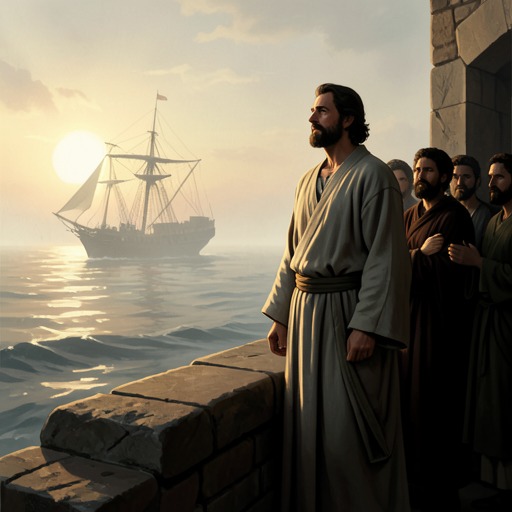
After speaking, Almustafa signals to the seamen. They weigh anchor, cast the ship loose from its moorings, and move eastward. These practical actions give physical form to the farewell: the ship is no longer waiting at its berth, and the people can no longer address a traveler who remains among them. The eastward movement is the decisive change in the scene, converting the promised departure into a journey under way.
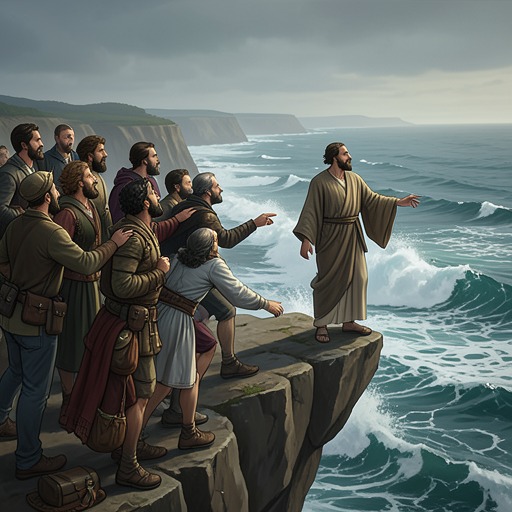
The people cry out as if from a single heart. Their shared cry rises through the dusk and carries over the sea like a great trumpet call, giving their response a scale that matches the public gathering. Yet the collective expression cannot hold the ship in place. The departure separates the people from Almustafa even as their common voice makes visible the attachment they share with him.
Almitra’s Vigil and the Ending
Almitra alone remains silent. She watches the ship until it vanishes into the mist, and after the people have dispersed she still stands alone on the sea-wall, remembering what Almustafa has said. The contrast is exact: the crowd gives its farewell in a single cry, while Almitra’s response is continued attention and remembrance. Her stillness does not undo the separation; it registers its personal weight after the public gathering has broken apart.
The ship’s disappearance closes the visible action, but Almitra’s remembering carries Almustafa’s words beyond the moment of departure. The scene ends not with the crowd or the ship in view, but with one witness left at the edge of the sea. That shift makes the farewell both communal and intimate: Orphalese sends Almustafa away together, while Almitra remains to hold the final encounter in memory.